Welcome to our Space

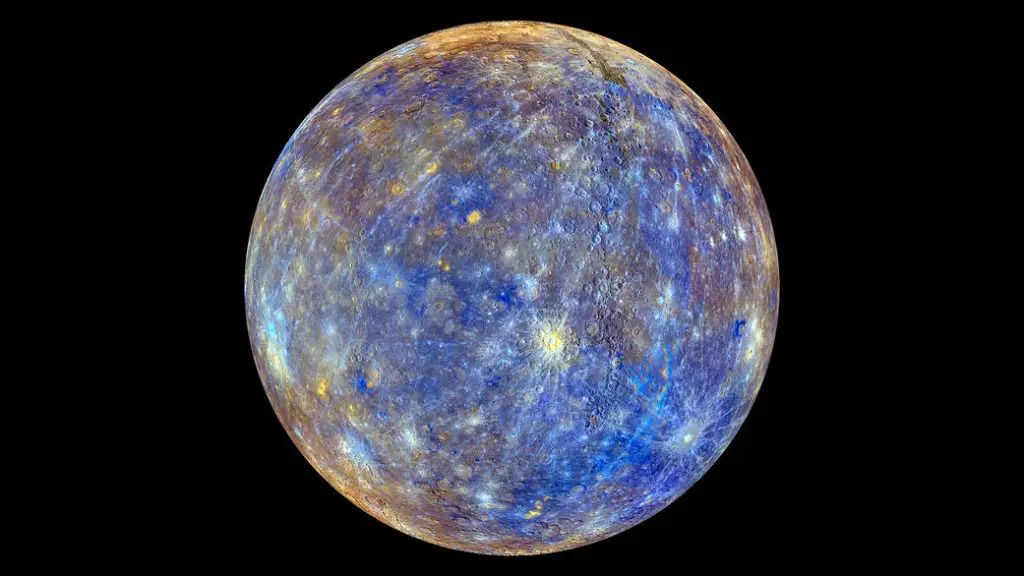
Mercury Image

Mercury

Mercury is the smallest planet in our solar system and the nearest to the Sun. Mercury is only slightly larger than Earth's Moon. Its surface is covered in tens of thousands of impact craters. Despite its proximity to the Sun, Mercury is not the hottest planet in our solar system; that title belongs to nearby Venus, thanks to its dense atmosphere. But Mercury is the fastest planet, zipping around the Sun every 88 Earth days. Mercury is appropriately named for the swiftest of the ancient Roman gods.
GLB Model Viewer

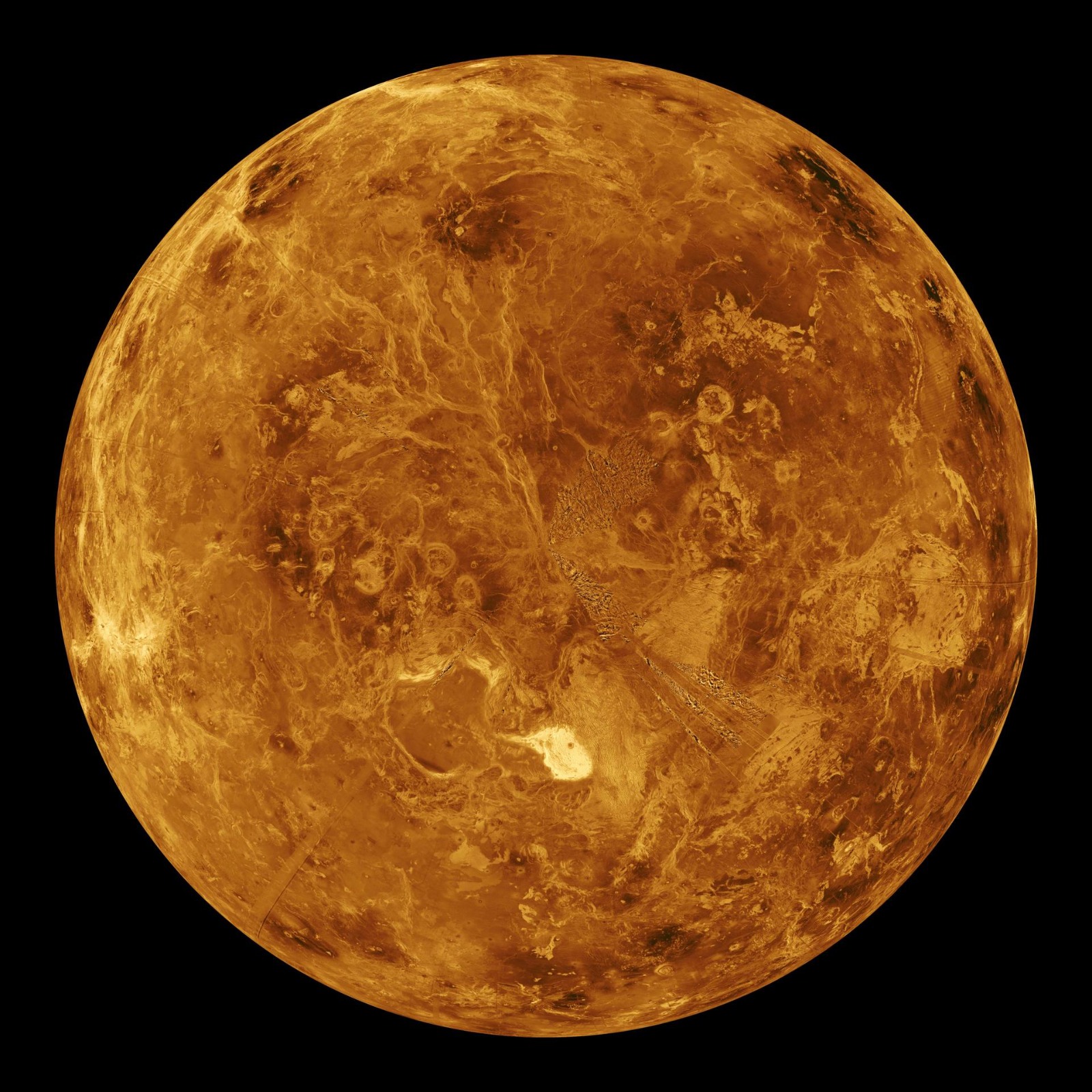
Venus

Venus is the second planet from the Sun, and the sixth largest planet. Its the hottest planet in our solar system. Venus is a cloud-swaddled planet named for a love goddess, and often called Earth’s twin. But pull up a bit closer, and Venus turns hellish. Our nearest planetary neighbor, the second planet from the Sun, has a surface hot enough to melt lead. The atmosphere is so thick that, from the surface, the Sun is just a smear of light.

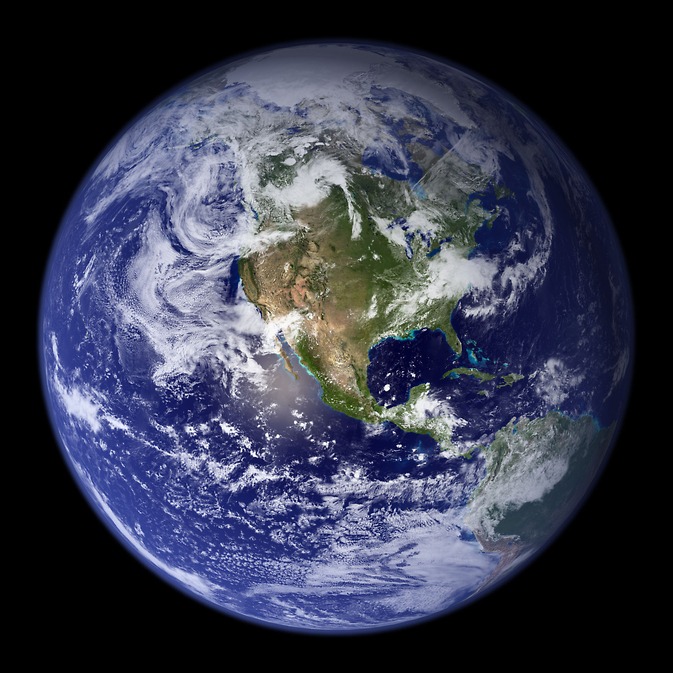
Earth

Earth, our home planet, is the third planet from the sun. It is the only place in the known universe confirmed to host life. Earth has a radius of 3,959 miles and is the fifth largest planet in our solar system1. It is the only planet known to have liquid water on its surface. Earth was formed approximately 4.54 billion years ago and is the only known planet to support life. It orbits in the Sun's "Goldilocks zone", a region where liquid water can exist on the surface of a rocky world. Earth, our home planet, is a world unlike any other. The third planet from the sun, Earth is the only place in the known universe confirmed to host life. With a radius of 3,959 miles, Earth is the fifth largest planet in our solar system, and it's the only one known for sure to have liquid water on its surface. Earth is also unique in terms of monikers. Every other solar system planet was named for a Greek or Roman deity, but for at least a thousand years, some cultures have described our world using the Germanic word earth, which means simply the ground.

Mars

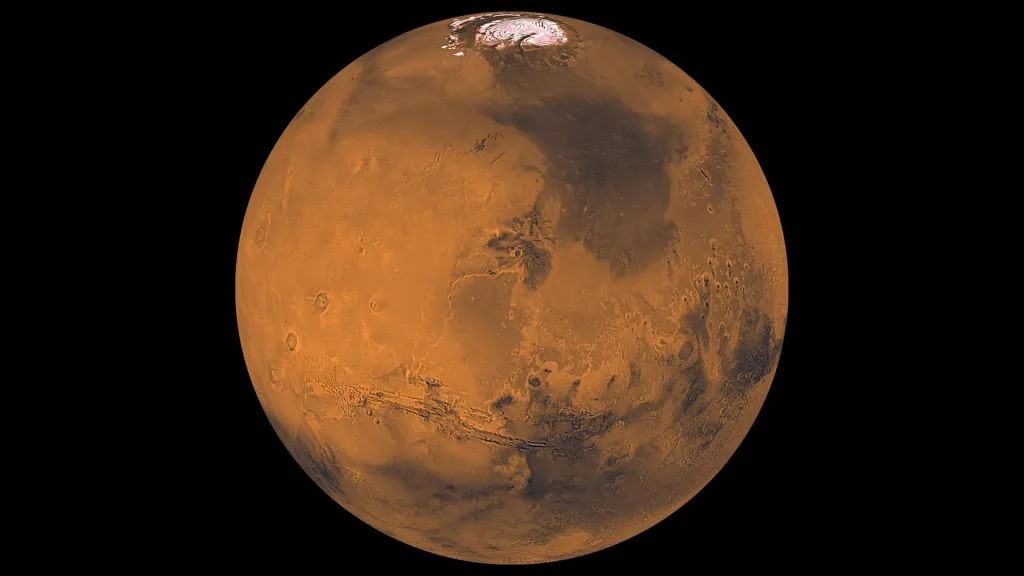
Namesake Mars was named by the ancient Romans for their god of war because its reddish color was reminiscent of blood. Other civilizations also named the planet for this attribute – for example, the Egyptians called it "Her Desher," meaning "the red one." Even today, it is frequently called the "Red Planet" because iron minerals in the Martian dirt oxidize, or rust, causing the surface to look red. Potential for Life Scientists don't expect to find living things currently thriving on Mars. Instead, they're looking for signs of life that existed long ago, when Mars was warmer and covered with water. Size and Distance With a radius of 2,106 miles (3,390 kilometers), Mars is about half the size of Earth. If Earth were the size of a nickel, Mars would be about as big as a raspberry. From an average distance of 142 million miles (228 million kilometers), Mars is 1.5 astronomical units away from the Sun. One astronomical unit (abbreviated as AU), is the distance from the Sun to Earth. From this distance, it takes sunlight 13 minutes to travel from the Sun to Mars. Orbit and Rotation As Mars orbits the Sun, it completes one rotation every 24.6 hours, which is very similar to one day on Earth (23.9 hours). Martian days are called sols – short for "solar day." A year on Mars lasts 669.6 sols, which is the same as 687 Earth days. Mars' axis of rotation is tilted 25 degrees with respect to the plane of its orbit around the Sun. This is another similarity with Earth, which has an axial tilt of 23.4 degrees. Like Earth, Mars has distinct seasons, but they last longer than seasons here on Earth since Mars takes longer to orbit the Sun (because it's farther away). And while here on Earth the seasons are evenly spread over the year, lasting 3 months (or one quarter of a year), on Mars the seasons vary in length because of Mars' elliptical, egg-shaped orbit around the Sun. Spring in the northern hemisphere (autumn in the southern) is the longest season at 194 sols. Autumn in the northern hemisphere (spring in the southern) is the shortest at 142 days. Northern winter/southern summer is 154 sols, and northern summer/southern winter is 178 sols. Moons Mars has two small moons, Phobos and Deimos, that may be captured asteroids. They're potato-shaped because they have too little mass for gravity to make them spherical. The moons get their names from the horses that pulled the chariot of the Greek god of war, Ares.

Jupiter

Introduction Jupiter's signature stripes and swirls are actually cold, windy clouds of ammonia and water, floating in an atmosphere of hydrogen and helium. The dark orange stripes are called belts, while the lighter bands are called zones, and they flow east and west in opposite directions. Jupiter’s iconic Great Red Spot is a giant storm bigger than Earth that has raged for hundreds of years. The king of planets was named for Jupiter, king of the gods in Roman mythology. Most of its moons are also named for mythological characters, figures associated with Jupiter or his Greek counterpart, Zeus. Namesake Jupiter, being the biggest planet, gets its name from the king of the ancient Roman gods. Potential for Life Jupiter’s environment is probably not conducive to life as we know it. The temperatures, pressures, and materials that characterize this planet are most likely too extreme and volatile for organisms to adapt to. While planet Jupiter is an unlikely place for living things to take hold, the same is not true of some of its many moons. Europa is one of the likeliest places to find life elsewhere in our solar system. There is evidence of a vast ocean just beneath its icy crust, where life could possibly be supported. Size and Distance With a radius of 43,440.7 miles (69,911 kilometers), Jupiter is 11 times wider than Earth. If Earth were the size of a grape, Jupiter would be about as big as a basketball. From an average distance of 484 million miles (778 million kilometers), Jupiter is 5.2 astronomical units away from the Sun. One astronomical unit (abbreviated as AU), is the distance from the Sun to Earth. From this distance, it takes sunlight 43 minutes to travel from the Sun to Jupiter.

Saturn

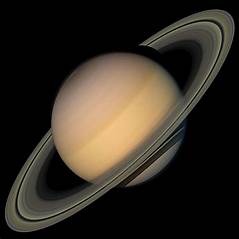
Introduction Like fellow gas giant Jupiter, Saturn is a massive ball made mostly of hydrogen and helium. Saturn is not the only planet to have rings, but none are as spectacular or as complex as Saturn's. Saturn also has dozens of moons. From the jets of water that spray from Saturn's moon Enceladus to the methane lakes on smoggy Titan, the Saturn system is a rich source of scientific discovery and still holds many mysteries. Namesake The farthest planet from Earth discovered by the unaided human eye, Saturn has been known since ancient times. The planet is named for the Roman god of agriculture and wealth, who was also the father of Jupiter. Potential for Life Saturn's environment is not conducive to life as we know it. The temperatures, pressures, and materials that characterize this planet are most likely too extreme and volatile for organisms to adapt to. While planet Saturn is an unlikely place for living things to take hold, the same is not true of some of its many moons. Satellites like Enceladus and Titan, home to internal oceans, could possibly support life. Size and Distance With an equatorial diameter of about 74,897 miles (120,500 kilometers), Saturn is 9 times wider than Earth. If Earth were the size of a nickel, Saturn would be about as big as a volleyball. From an average distance of 886 million miles (1.4 billion kilometers), Saturn is 9.5 astronomical units away from the Sun. One astronomical unit (abbreviated as AU), is the distance from the Sun to Earth. From this distance, it takes sunlight 80 minutes to travel from the Sun to Saturn. Orbit and Rotation Saturn has the second-shortest day in the solar system. One day on Saturn takes only 10.7 hours (the time it takes for Saturn to rotate or spin around once), and Saturn makes a complete orbit around the Sun (a year in Saturnian time) in about 29.4 Earth years (10,756 Earth days). Its axis is tilted by 26.73 degrees with respect to its orbit around the Sun, which is similar to Earth's 23.5-degree tilt. This means that, like Earth, Saturn experiences seasons. Moons Saturn is home to a vast array of intriguing and unique worlds. From the haze-shrouded surface of Titan to crater-riddled Phoebe, each of Saturn's moons tells another piece of the story surrounding the Saturn system. As of June 8, 2023, Saturn has 146 moons in its orbit, with others continually awaiting confirmation of their discovery and official naming by the International Astronomical Union (IAU).

Uranus

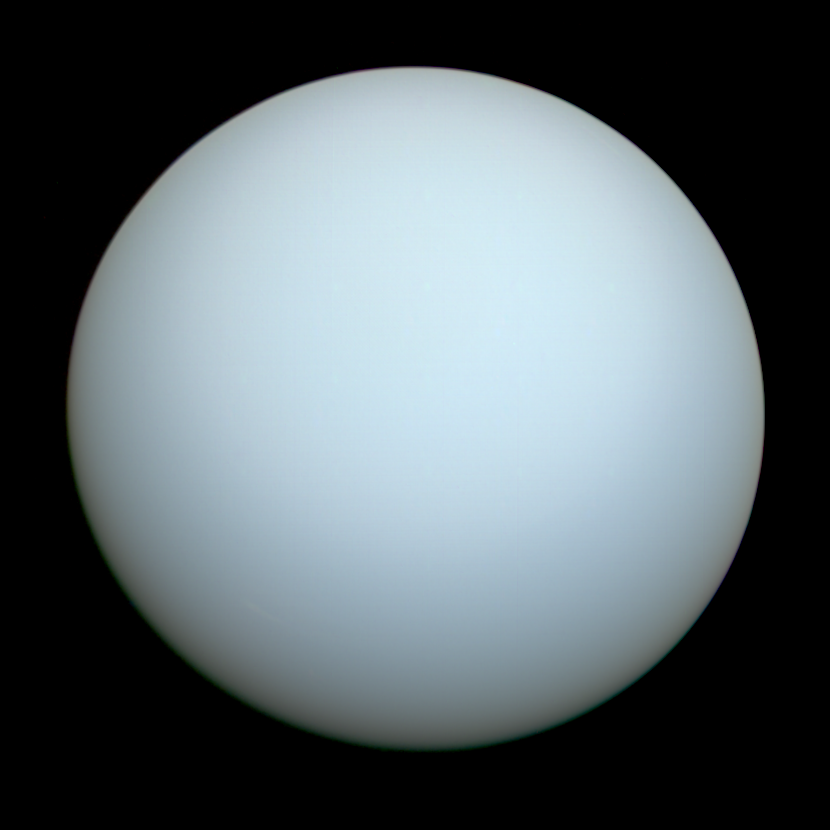
Introduction Uranus is a very cold and windy world. The ice giant is surrounded by 13 faint rings and 28 small moons. Uranus rotates at a nearly 90-degree angle from the plane of its orbit. This unique tilt makes Uranus appear to spin sideways, orbiting the Sun like a rolling ball. Uranus was the first planet found with the aid of a telescope. It was discovered in 1781 by astronomer William Herschel, although he originally thought it was either a comet or a star. It was two years later that the object was universally accepted as a new planet, in part because of observations by astronomer Johann Elert Bode. Namesake William Herschel tried unsuccessfully to name his discovery Georgium Sidus after King George III. Instead, the planet was named for Uranus, the Greek god of the sky, as suggested by Johann Bode. Potential for Life Uranus' environment is not conducive to life as we know it. The temperatures, pressures, and materials that characterize this planet are most likely too extreme and volatile for organisms to adapt to. Size and Distance With an equatorial diameter of 31,763 miles (51,118 kilometers), Uranus is four times wider than Earth. If Earth was the size of a nickel, Uranus would be about as big as a softball. From an average distance of 1.8 billion miles (2.9 billion kilometers), Uranus is about 19 astronomical units away from the Sun. One astronomical unit (abbreviated as AU), is the distance from the Sun to Earth. From this distance, it takes sunlight 2 hours and 40 minutes to travel from the Sun to Uranus. Orbit and Rotation One day on Uranus takes about 17 hours. This is the amount of time it takes Uranus to rotate, or spin once around its axis. Uranus makes a complete orbit around the Sun (a year in Uranian time) in about 84 Earth years (30,687 Earth days). Uranus is the only planet whose equator is nearly at a right angle to its orbit, with a tilt of 97.77 degrees. This may be the result of a collision with an Earth-sized object long ago. This unique tilt causes Uranus to have the most extreme seasons in the solar system. For nearly a quarter of each Uranian year, the Sun shines directly over each pole, plunging the other half of the planet into a 21-year-long, dark winter. Uranus is also one of just two planets that rotate in the opposite direction than most of the planets. Venus is the other. Moons Uranus has 28 known moons. While most of the satellites orbiting other planets take their names from Greek or Roman mythology, Uranus' moons are unique in being named for characters from the works of William Shakespeare and Alexander Pope. All of Uranus' inner moons appear to be roughly half water ice and half rock. The composition of the outer moons remains unknown, but they are likely captured asteroids. Rings Uranus has two sets of rings. The inner system of nine rings consists mostly of narrow, dark grey rings. There are two outer rings: the innermost one is reddish like dusty rings elsewhere in the solar system, and the outer ring is blue like Saturn's E ring. In order of increasing distance from the planet, the rings are called Zeta, 6, 5, 4, Alpha, Beta, Eta, Gamma, Delta, Lambda, Epsilon, Nu, and Mu. Some of the larger rings are surrounded by belts of fine dust.

Neptune

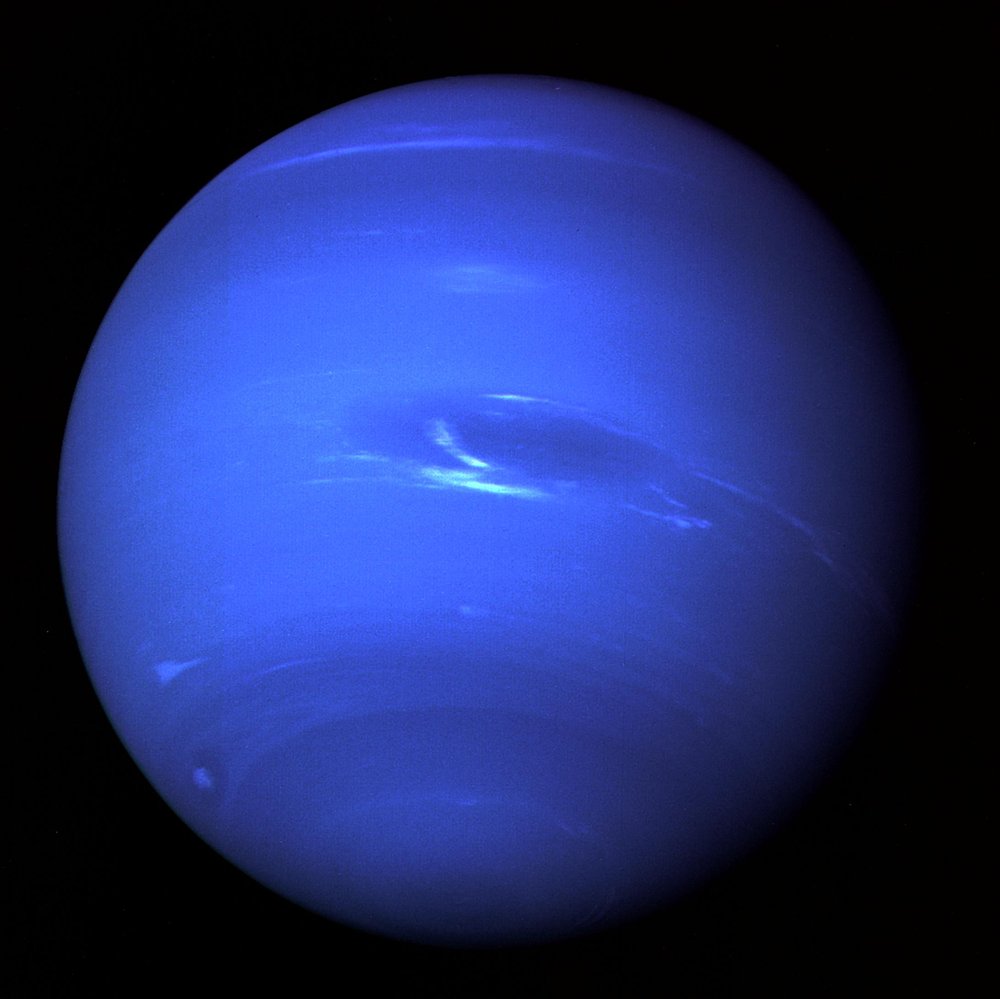
Introduction Dark, cold, and whipped by supersonic winds, ice giant Neptune is more than 30 times as far from the Sun as Earth. Neptune is the only planet in our solar system not visible to the naked eye. In 2011 Neptune completed its first 165-year orbit since its discovery in 1846. Neptune is so far from the Sun that high noon on the big blue planet would seem like dim twilight to us. The warm light we see here on our home planet is roughly 900 times as bright as sunlight on Neptune. Namesake The ice giant Neptune was the first planet located through mathematical calculations. Using predictions made by Urbain Le Verrier, Johann Galle discovered the planet in 1846. The planet is named after the Roman god of the sea, as suggested by Le Verrier. Potential for Life Neptune's environment is not conducive to life as we know it. The temperatures, pressures, and materials that characterize this planet are most likely too extreme, and volatile for organisms to adapt to. Size and Distance With an equatorial diameter of 30,775 miles (49,528 kilometers), Neptune is about four times wider than Earth. If Earth were the size of a nickel, Neptune would be about as big as a baseball. From an average distance of 2.8 billion miles (4.5 billion kilometers), Neptune is 30 astronomical units away from the Sun. One astronomical unit (abbreviated as AU), is the distance from the Sun to Earth. From this distance, it takes sunlight 4 hours to travel from the Sun to Neptune. Orbit and Rotation One day on Neptune takes about 16 hours (the time it takes for Neptune to rotate or spin once). And Neptune makes a complete orbit around the Sun (a year in Neptunian time) in about 165 Earth years (60,190 Earth days). Sometimes Neptune is even farther from the Sun than dwarf planet Pluto. Pluto's highly eccentric, oval-shaped orbit brings it inside Neptune's orbit for a 20-year period every 248 Earth years. This switch, in which Pluto is closer to the Sun than Neptune, happened most recently from 1979 to 1999. Pluto can never crash into Neptune, though, because for every three laps Neptune takes around the Sun, Pluto makes two. This repeating pattern prevents close approaches of the two bodies. Neptune’s axis of rotation is tilted 28 degrees with respect to the plane of its orbit around the Sun, which is similar to the axial tilts of Mars and Earth. This means that Neptune experiences seasons just like we do on Earth; however, since its year is so long, each of the four seasons lasts for over 40 years. Moons Neptune has 16 known moons. Neptune's largest moon Triton was discovered on Oct. 10, 1846, by William Lassell, just 17 days after Johann Gottfried Galle discovered the planet. Since Neptune was named for the Roman god of the sea, its moons are named for various lesser sea gods and nymphs in Greek mythology. Triton is the only large moon in the solar system that circles its planet in a direction opposite to the planet's rotation (a retrograde orbit), which suggests that it may once have been an independent object that Neptune captured. Triton is extremely cold, with surface temperatures around minus 391 degrees Fahrenheit (minus 235 degrees Celsius). And yet, despite this deep freeze at Triton, Voyager 2 discovered geysers spewing icy material upward more than 5 miles (8 kilometers). Triton's thin atmosphere, also discovered by Voyager, has been detected from Earth several times since, and is growing warmer, but scientists do not yet know why. Rings Neptune has at least five main rings and four prominent ring arcs that we know of so far. Starting near the planet and moving outward, the main rings are named Galle, Leverrier, Lassell, Arago, and Adams. The rings are thought to be relatively young and short-lived.